I think it's so much more about profession and aspiration: Do you aspire to have a big house in the suburbs? It's not a question of whether you have one or can afford one. I think you can sort people out according to their goals, not whether they have the means to achieve them. That, to me, is a more interesting way of looking at class -- rather than income.
From an interview with writer Susan Orlean by Manjula Martin in Scratch.
Tuesday, October 31, 2017


Wednesday, April 12, 2017
Thoughts on Uniforms for ARS
My eldest daughter goes to the Ann Richards School for Young Women Leaders. I shared our experiences and thoughts on uniforms with some friends, and thought I'd publish it here, too, for anyone else who is looking for information.
So the only thing we bought through Parker was the skirt. They are sized based on waist measurement. We bought 2 -- on "today's" size and one one size up. The skirt is good for 7 years, uniform-wise, so it's worth buying. When you go for orientation, PTA will have a uniform sale -- I'd go there first thing (get there slightly early, it was in the small gym last year) if you want to try to buy a 2nd hand one. Skirts are by far the most popular uniform item. The girls wear them with bike shorts or athletic shorts underneath, so they are definitely a multi-wear-before-wash. I think you could get away with just 1.
So the only thing we bought through Parker was the skirt. They are sized based on waist measurement. We bought 2 -- on "today's" size and one one size up. The skirt is good for 7 years, uniform-wise, so it's worth buying. When you go for orientation, PTA will have a uniform sale -- I'd go there first thing (get there slightly early, it was in the small gym last year) if you want to try to buy a 2nd hand one. Skirts are by far the most popular uniform item. The girls wear them with bike shorts or athletic shorts underneath, so they are definitely a multi-wear-before-wash. I think you could get away with just 1.
I
also bought 5 white polos from Gap during their July uniform sale.
They were around $8 each, and cuter than a lot of the other brands
(peter pan collars, slim fit). Target, H&M, etc all sell white
uniform polos, so they are easy to find when back-to-school starts
ramping up. You'll want enough to last a full laundry cycle. I expect
to replace the shirts annually -- the white gets dingy.
They
have jeans days about once a month, which you have to wear with a Ann
Richards T-Shirt of some kind. (So it's worth buying one when given the
option. Savannah has a super cute grey one that says "Richards" across
the front -- I'm not sure where/when she got it.) J. managed to
lose/have stolen the only t-shirt she had. (You can also use the ARS Ts
for gym class, which is where J.'s disappeared -- perhaps locking
her gym locker would have helped.)
Shoes need to be
solid white athletic lace up shoes, but any kind will do. Just be
careful how much branding/bling they have on them -- "Keds" on the heel
is fine, large green "Keds" on the tongue not to so fine (although it's
unclear if you can get away with the 2nd -- J. is very
conservative). They wear them every day, so finding a good pair makes
sense. I ordered a bunch from Zappos and sent back all but one. If
J. hadn't of liked this pair of very lightweight "old lady tourist"
shoes, we would have gone with leather Keds -- leather is easy to keep
clean and the style is classic.
Socks need to be white
(or possibly black?) and visible when wearing shoes. The knee high
ones are popular with the skirt, but I'd get a mix of shorter ones as
well. Target for the shorter ones; I had to order the knee high ones
(J. got them for Christmas.). I bet Parker has knee high ones.
J.
has 2 pair of black pants we found at thrift stores. (Not hard to do,
and they are more comfortable than the Parker ones.) They must have
belt loops, and you must wear a black belt with them. We found a
"slightly interesting" belt at Target. She wears pants maybe once a
month, so not that popular, but good for the cold. She also has to wear
them for choir concerts.
J. has 2 pair of black
shorts, but I'm not sure she's ever worn them. She prefers skirts when
it gets warm. I ordered from Target, but they are chino/twill fabric
and don't have any stretch which might be part of their unpopularity.
They'll
need black gym shorts (that "wind breaker" sort of fabric). A little
bit of color is OK. J. managed to lose 2 pair so far this year.
They'll
also need a black jacket/sweater/coat/pull over. J.'s favorites are
hoodies (I found a cashmere one at a thrift store that was popular) or
leather(look) jackets (very popular). Easily found 2nd hand.
Hair ornaments need to be black or blue or blend with your hair. Parker has some cute bows and headbands (not sure if I've ever seen anyone wearing them, though). Cut hair things in black are popular (kitty cat headbands, "Friday" bobby pins), but J. for the most part just wears a ponytail or silver clips or a headband.
That's all
they have to have. I have 2 things on my list for "nice to have" for
next year, but I haven't asked J. if she wants them. There's a ARS
black v-neck pullover at Parker that looks super sharp over the polos in
the winter. (I think a non-ARS pullover would work as well.) There's
also a white button up at Parker that has princess seams and the ARS
logo that's a cute option.
Hair ornaments need to be black or blue or blend with your hair. Parker has some cute bows and headbands (not sure if I've ever seen anyone wearing them, though). Cut hair things in black are popular (kitty cat headbands, "Friday" bobby pins), but J. for the most part just wears a ponytail or silver clips or a headband.
Thursday, October 20, 2016
Blank? in Ruby On Rails
The blank? method (a clever Rails extension for those of us too lazy to figure out what type of object we are testing is) is some very smart code:
[7] pry(#<#>)> nil.blank?
=> true
[8] pry(#<#>)> "".blank?
=> true
[9] pry(#<#>)> [].blank?
=> true
[10] pry(#<#>)> {}.blank?
=> true
[11] pry(#<#>)> find-method blank?
Object
Object#blank?
[12] pry(#<#>)> show-source blank?
From: /home/saracarl/.rvm/gems/ruby-2.2.0-preview2/gems/activesupport-4.1.2/lib/active_support/core_ext/object/blank.rb @ line 16:
Owner: Object
Visibility: public
Number of lines: 3
def blank?
respond_to?(:empty?) ? !!empty? : !self
end
Let's break it down
respond_to?(:empty?) ?
if the object has a method called empty?
!!empty?
return the results of empty?, "not"-ed twice. This means if the response to emtpy? is "true" it will return true (!(!true)). If the response is false it will return false (!(!false)) If the response is "nil" it will return false (!(!nil)). It covers the case where empty? returns nil instead of true or false -- if the object.empty? is nil, then the object.blank? is false
: !self
Else return !self -- if self is nil, return true, otherwise return false.
[7] pry(#<#
=> true
[8] pry(#<#
=> true
[9] pry(#<#
=> true
[10] pry(#<#
=> true
[11] pry(#<#
Object
Object#blank?
[12] pry(#<#
From: /home/saracarl/.rvm/gems/ruby-2.2.0-preview2/gems/activesupport-4.1.2/lib/active_support/core_ext/object/blank.rb @ line 16:
Owner: Object
Visibility: public
Number of lines: 3
def blank?
respond_to?(:empty?) ? !!empty? : !self
end
Let's break it down
respond_to?(:empty?) ?
if the object has a method called empty?
!!empty?
return the results of empty?, "not"-ed twice. This means if the response to emtpy? is "true" it will return true (!(!true)). If the response is false it will return false (!(!false)) If the response is "nil" it will return false (!(!nil)). It covers the case where empty? returns nil instead of true or false -- if the object.empty? is nil, then the object.blank? is false
: !self
Else return !self -- if self is nil, return true, otherwise return false.
Sunday, January 10, 2016
The Theory of Four Things
When you get to a certain tenure in the high tech industry, you've probably worked in a number of programming languages. My education started with hobbyist BASIC, continued with high school Pascal, and finished with Scheme and C in college. My professional life until this year included Java, perl, and bash, and I picked up Ruby for fun side projects. Those transitions and additions happened over years. In the last 4 months, however, I've done projects in both javascript (node.js) and Python. That's a lot to learn in a short period of time, and I'm by no means an expert yet. However, I've seen enough patterns in modern web programming languages to state the following -- we'll call it The Theory of Four Things:
To be productive in a new web programming language, you only need to understand four things.
How do to find, install and load the languages libraries; how to reference the library’s methods.
How do you print an output message? How do you take a substring? (related: master regular expressions because most modern programming languages use them for string matching.)
Most server-to-server communication is done with JSON documents these days. Make sure you know how to put things into JSON format and get things out of a JSON object (or as Stack Overflow will probably tell you “a string that just happens to be a JSON object”).
Those aforementioned JSON documents flow via REST API requests, all bundled up into HTTP requests. Know how to create them, and how to troubleshoot them (this is where knowledge of networks and security comes in useful).
To be productive in a new web programming language, you only need to understand four things.
Libraries.
How do to find, install and load the languages libraries; how to reference the library’s methods.
String Manipulation.
How do you print an output message? How do you take a substring? (related: master regular expressions because most modern programming languages use them for string matching.)
Accessing and creating JSON documents.
Most server-to-server communication is done with JSON documents these days. Make sure you know how to put things into JSON format and get things out of a JSON object (or as Stack Overflow will probably tell you “a string that just happens to be a JSON object”).
HTTP requests.
Those aforementioned JSON documents flow via REST API requests, all bundled up into HTTP requests. Know how to create them, and how to troubleshoot them (this is where knowledge of networks and security comes in useful).
Monday, July 06, 2015
Letter to Camp #2
My 10 year old is away at sleep over camp -- a RenFair camp,
since that's what's compelling enough to spend 6 nights away from home
if you are the child of two geeks. Here's the second letter I wrote to
her.
Dear J --
I hope you are learning how to defend our castle in case of attack. It's very important job and you know that your dad and I are too busy writing software to learn the intricacies of archery or jousting. It's all in your hands.
Similarly, when you return your responsibilities will include the care and maintenance of all of our leatherwork. That will make my life even more easier than when you learned to clean out the dishwasher!
Have your magic skills increased to the point you can make broccoli disappear, yet? If that's the case, this camp is worth every cent! (Heck, I'd even be satisfied if you could only make green beans disappear.)
So there is supposed to be swimming every day at this camp, but there were no swimming pools in renaissance England that I'm aware of. I assume, therefore, that you are swimming in the moat to the castle. Do be careful, J. Those moats often have sea monsters in them imported from the Far East.
I expect that you haven't brushed your hair once since arriving -- don't worry, I think the classic short "page boy" haircuit you'll have after we cut the snarls and tangles out will suit your new knowledge of chivalry very well.
One thing I am looking forward to after your return is increased bravery -- surely taking hot dishes out of the oven will be a piece of cake after blacksmithing!
Love you lots!
Mom

Dear J --
I hope you are learning how to defend our castle in case of attack. It's very important job and you know that your dad and I are too busy writing software to learn the intricacies of archery or jousting. It's all in your hands.
Similarly, when you return your responsibilities will include the care and maintenance of all of our leatherwork. That will make my life even more easier than when you learned to clean out the dishwasher!
Have your magic skills increased to the point you can make broccoli disappear, yet? If that's the case, this camp is worth every cent! (Heck, I'd even be satisfied if you could only make green beans disappear.)
So there is supposed to be swimming every day at this camp, but there were no swimming pools in renaissance England that I'm aware of. I assume, therefore, that you are swimming in the moat to the castle. Do be careful, J. Those moats often have sea monsters in them imported from the Far East.
I expect that you haven't brushed your hair once since arriving -- don't worry, I think the classic short "page boy" haircuit you'll have after we cut the snarls and tangles out will suit your new knowledge of chivalry very well.
One thing I am looking forward to after your return is increased bravery -- surely taking hot dishes out of the oven will be a piece of cake after blacksmithing!
Love you lots!
Mom

Letter to Camp #1
My 10 year old is away at sleep over camp -- a RenFair camp, since that's what's compelling enough to spend 6 nights away from home if you are the child of two geeks. Here's the first letter I wrote to her.
 Dear J,
I hope you are having a wonderful time at camp.
Things I hope you are enjoying:
meeting new people who think renfair camp is as cool as you do
fighting with swords
living in the forest
bug bites
swimming
sweat
enough food to keep you going
a good night's rest after a busy day
archery
living away from your parents
pretending to live in the 15th century
sleeping in a castle
figuring out just a little bit of life on your own
What we are enjoying without you here:
swim lessons with T
earlier bedtimes
fewer drop offs in the morning
missing you
ice cream
(in other words: you are not missing much, except for the ice cream!)
Be Brave. Try something that scares you every day.
Love,
Mom
p.s. I hope you are getting ice cream, too.

I hope you are having a wonderful time at camp.
Things I hope you are enjoying:
meeting new people who think renfair camp is as cool as you do
fighting with swords
living in the forest
bug bites
swimming
sweat
enough food to keep you going
a good night's rest after a busy day
archery
living away from your parents
pretending to live in the 15th century
sleeping in a castle
figuring out just a little bit of life on your own
What we are enjoying without you here:
swim lessons with T
earlier bedtimes
fewer drop offs in the morning
missing you
ice cream
(in other words: you are not missing much, except for the ice cream!)
Be Brave. Try something that scares you every day.
Love,
Mom
p.s. I hope you are getting ice cream, too.
Saturday, March 07, 2015
Favorite STEM Books: Psst!


With the help of a young tomboy, a group of zoo animals gather parts to engineer their escape. Illustrator & writer Adam Rex includes plenty of clever visual jokes that parents appreciate in his intricately designed zooscape. Both girls like this book -- so it's appropriate for at least ages 4 through 9.
A gift from one of my best friends, who happens to be Ph. D. in Electrical Engineering and work at Google. She's one of my girls' biggest fans when it comes to achievement in math and science -- when the eldest brought her math grade up from a B (gasp) to an A+, she sent one of the most amazing wooden puzzles for her good work.)
Wednesday, July 09, 2014
Feeding my kids: Breakfast
A friend just asked what I feed my kids for breakfast. Here's what I told her:
2) fruit at every meal (or veg, if I could make that work)
3) I think everyone's blood sugar is more even with protein at breakfast.
and bonus: Ben and I take turns which makes #1 easier, but I still have to make #2 happen personally.
Example Breakfasts:
not all for the girls, but gives some ideas...

My 3 guidelines are:
1) vary
breakfast/meals as much as possible (we try for 5-7 different meals for
breakfast) -- variation hopefully leads to more openness about all food
reference: Tavie is 3 and Josie is 9
- yogurt "sundaes" -- greek yogurt (sometimes plain, sometimes vanilla) with frozen fruit defrosted to be saucy and a sprinkle of cereal and a drizzle of chocolate syrup
- steel cut oats -- I parboil these in the microwave the night before and then it's just 5 minutes in the morning. Josie likes hers with pesto/cheese/bacon bits; Tavie likes hers with chocolate chips (sigh).
- pancakes made with one of the bob's red mill pancake mixes (make on the weekends and serve leftovers)
- frozen waffles (kashi or similar)
- grits -- I buy the frozen "true grits" from HEB (Josie only, Tavie won't eat)
- cheese toast -- multigrain "good bread" with sharp cheddar melted on top
- french toast made with good bread and egg substitute (makes it easier/faster)
- scrambled eggs (Tavie only, sigh)
- boiled eggs (Tavie only again)
- peanut butter + banana + honey open faced sandwich (Tavie deconstructs, oh well)
- apples slices and peanut butter/almond butter
- refrigerator biscuits (the ones with some whole grain/bran) with bacon
- muffins (freeze & defrost) -- I can share the whole grain, lower sugar recipes I've found
- sausage -- either the natural stuff (applegate farms?) or the not-so-good but oh-so-popular lil smokies (turkey)
- sweet quinoa -- made with half milk/water, stir in chocolate chips
I'm sure there is more, but that's most of our rotation.
I also think it's perfectly reasonable to serve dinner foods for
breakfast. I offer leftovers for breakfast as a way to encourage my
kids to stop eating chicken fingers and french fries (sigh) when they
are sated, rather that overstuff themself.
And my breakfast ideas pinterest board: http://www.pinterest.com/not all for the girls, but gives some ideas...
Monday, May 26, 2014
Matagorda, TX Beach Trip

The trip from Austin is about 3 1/2 hours, a full hour less than it takes us to get to Aransas. It's a tiny town, with about 4 restaurants, 3 gift shoppes, a seafood market and a convenience store with some groceries. (We picked up supplies in Bay City at a very nice HEB -- but it's 30-40 minutes from the beach.)
The history is interesting -- Matagorda was settled to protect colonists coming to Stephen F. Austin's original colony, there are historical markers all over town, and we noticed a Episcopal church claiming to be the (Episcopalian) "mother church of Texas."
The geography is also interesting. Matagorda is where the Colorado River runs into the Gulf of Mexico, so in addition to the ocean and wetlands, there's a lot of river recreation. We stayed at a beach condo but there were lots of houses lining the river for people with boats and a love of fishing.
The river was actually what saved our trip. The Texas coast is experiencing a crazy influx of sargasso seaweed on shore right now. So when we went to the beach, there was 10 yards or more of solid red seaweed two feet high between us and the ocean. Our neighbors down the beach had brought a shovel and were shovelling a path through the seaweed -- it took them about 40 minutes of work -- but they were kind enough to let our group use it to get to the ocean to swim. (And the ocean was full of seaweed, too.) I didn't actually swim, but sat and built sand castles and read magazines in the sun.
[side note: According to the Texas A&M Galveston Sargassum Early Advisory System:
Public use of these beaches can be severely restricted by the periodic mass landings of the free-floating algae Sargassum, commonly referred to as Seaweed. These Sargassum episodes often occur with little or no warning. They can last for weeks at a time, usually during the prime tourist season. So I don't hold the seaweed against Matagorda.]
If that had been the sum total of our beach experience, I would have been very disappointed. (And since this was our first time at Matagorda, we all wondered if it was like this all the time. Ben even went so far as to ask how long it would take to drive to Port Aransas! Both of us were worried about the impression our guests and Texas beach newbie friends were getting.) Luckily, the Lower Colorado River Authority had a park right where the river met the ocean that had both sand and no seaweed. We spent our second morning there and finally had the beach experience we wanted. (Without waves, but that was OK too.)

We stayed at perhaps the only condo complex at the beach itself -- Bahia de Matagorda #9. The complex was very nice -- a large pool with a very 1980s swim up bar with in-pool bar stools (and a large sign saying "no glass, no eating or drinking in the pool"). I wouldn't think a pool is a requisite for a beach trip, but our last 4 have had a pool, and it makes coming in from the beach much easier. You shower off in the outside shower on the way to the pool, then use the pool to cool off after a hot time at the beach. The pool was actually on an "island" surrounded by a lagoon -- the lagoon added a nice atmosphere, and we saw some another guest kayaking in the lagoon. (And a big surprise -- the big girls watched a turtle dive into the pool as we got there this morning -- nets were fetched to get it out, but it was an exciting 15 minutes!)
We mostly cooked in the condo, but we did get dinner out one night at Riverbend Restaurant & Tavern. The large signs warning that the kitchen can take 40+ minutes to get food out once they get busy were a bit disconcerting, but we arrived at 5:15 and had a food in reasonable time. The food was good for what it was -- fresh, fried seafood. My french fry aficionado says the fries were boring. They had fried okra as an appetizer, which was a surprising hit with the kiddos, even if it was just a vehicle for batter, salt, and ranch dressing.
The moms sneaked out to grab fancy coffee at Cattails once we had everyone settled on the beach. The coffee was a surprise -- good lattes and mochas in a charming gift shoppe/wine bar/coffee bar attached to a surpisingly upscale Karankawa Village Lodge.
I alluding to wanting a "cheap and easy" beach trip, and this one was definitely more affordable than Port Aransas. We spent $225/night for a 3 bedroom condo that easily accommodated two families. That's hard to beat!
Will we be back? I suspect we will, but the seaweed was enough of a damper (ahem!) to color our experience (even though that wasn't unique to Matagorda, but to our trip time) that we may try someplace else before we make it back.
Saturday, November 09, 2013
Things I Like
I was considering calling this the "Things I Like -- Frugal Edition", but really, anything I really enjoy is going to be relatively frugal, because spending money carelessly is not something I like. Perhaps I should call this "Things I Like -- Fun Edition" because both of these are fun. Cheap fun.

First, Yellow Tail Bubbles. These are solid champagnes (flat, the white is a bit Gewürztraminer-like), but the brilliance comes in the cork. The Zork, to be exact, a resealable champagne cork that works better than any champagne-sealing-solution I've tried before. I can open one of these babies for Friday Happy Hour, have a glass or two a day, and still have plenty of nose tickling bubbles by Wednesday. Amazing, really. Moderate champagne consumption, without those silly little bottles. Yellow Tail even has a video about the Zork.

Second, these Ikea funnels. (We have the red ones.) They made great bath and pool toys all summer, but where they really shined was at the beach last month. The dome shape made for awesome futuristic cities and dome topped ziggurats (bucket + funnel).
.JPG)
And the funnel itself could be filled with wet sand and dripped into drip castles or used to decorate the aforementioned cities. Hard to beat for $1.
.JPG)

First, Yellow Tail Bubbles. These are solid champagnes (flat, the white is a bit Gewürztraminer-like), but the brilliance comes in the cork. The Zork, to be exact, a resealable champagne cork that works better than any champagne-sealing-solution I've tried before. I can open one of these babies for Friday Happy Hour, have a glass or two a day, and still have plenty of nose tickling bubbles by Wednesday. Amazing, really. Moderate champagne consumption, without those silly little bottles. Yellow Tail even has a video about the Zork.
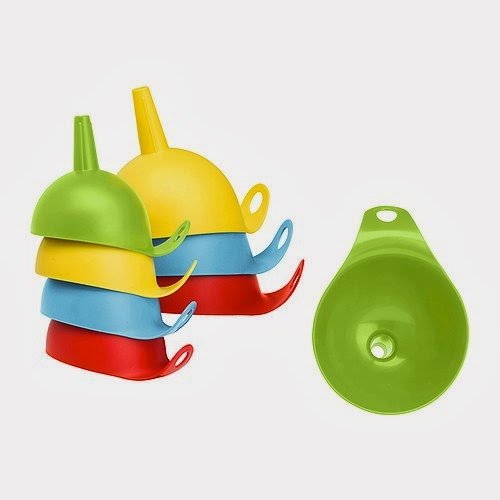
Second, these Ikea funnels. (We have the red ones.) They made great bath and pool toys all summer, but where they really shined was at the beach last month. The dome shape made for awesome futuristic cities and dome topped ziggurats (bucket + funnel).
.JPG)
And the funnel itself could be filled with wet sand and dripped into drip castles or used to decorate the aforementioned cities. Hard to beat for $1.
.JPG)
Monday, September 30, 2013
Lessons from Project 333

Throughout the project I kept a spreadsheet of what I wore, how often, and my thoughts on the individual pieces and outfits. I found this the most useful part of the project, allowing me to refine what worked, what didn't, and why. You can check out my spreadsheet.
 |
| One of my favorite outfits from the last 3 months |
Here are 10 of the lessons I learned during the project:
1) Fabric matters -- pay attention!
2) Dress for the life you have.
3) Comfort trumps style (but both together are great!).
4) Know what colors flatter you. For me, "soft autumn" colors like muted reds, greens, pinks, mustard yellow.
5) Know what flatters your shape.
6) With a small closet, everything has to earn it's place. If it's not carrying it's weight, let it go.
7) It's OK to wear the same dress 5 Sundays in a row, or the same skirt twice in a week, especially if you feel fabulous in it.
8) 1 piece you feel fabulous in is worth 3 that you feel OK in.
9) Accessories can add a lot of variety. (This project pushed me to use more accessories to spice up my wardrobe of basics.)
10) It's OK to spend a lot on one piece you will wear a whole bunch. It doesn't make as much sense to spend a lot on special occasion clothes.
Monday, July 29, 2013

Sunday, July 28, 2013

Saturday, July 27, 2013

Friday, July 26, 2013

Tuesday, July 23, 2013

Thursday, July 11, 2013
9 Ways to Simplify your PTA
1) Get out of the concessions business -- use food trucks instead.
Concessions are low-profit, high risk and take a lot of volunteers to run. Instead, hire a food truck to come and feed your folk -- the food may be better, and it's a lot more fun. Some vendors will even give you a small cut of their revenue from your event.
2) Move your volunteer sign ups online. Use SignUpGenius or VolunteerSpot. You no longer have to nag the same people to get volunteers. Your volunteer base will be wider. Added bonus: after a year, you'll have a record of how many volunteers you used last time!
3) Hold Spirit Nights. Spirit nights are events where your community shows up at a restaurant or entertainment venue to have fun together, and your PTA gets a cut of the money they spend. Our most successful spirit nights were roller skating -- fun for the whole family, healthy, low cost. All you have to do schedule the event and promote. (Some require teacher participation -- which is more work.)
4) Limit your spirit gear. "Spirit gear" -- t-shirts, coozies, sweatshirts, key rings, bags etc with your school's name on them. Inventory management is not simple, nor is it fun. Simplify this job by limiting your gear to a single shape & color of t-shirt. It's enough.
5) Limit your fundraisers. Pick the one that is the most profitable and/or "honest" and put a lot of effort behind it. Fundraisers are also a ton of work -- even the "easy" ones. Do one, and put a lot of effort into making it successful. If you're going to work that hard, make it one that feels "right", rather than a peer pressure project.
6) Look for high impact work. For us this was grants & community sponsorship. Find strong individuals to run that work.
7) Tie meetings in to school events -- and keep them short. Related -- find out the smallest number of general meetings you are required to have per your bylaws, and just have that many. Publicize board meetings or committee meetings for people who want to be involved. Consider sending out meeting minutes from board meetings via e-mail to keep people informed.
8) Provide information in as many ways as possible, but focus on electronic rather than physical media -- on a website, facebook, and an email list.
9) See if you can use your school's phone system to inform parents of events. This was our biggest PR win -- sending out voice alerts the afternoon before an event. I never tested it, but suspect that we could have done this and skipped newseletters, stickers, etc.
Sunday, December 02, 2012
How I eat
I've kept off a 40 pound plus weight loss for more than 4 years now, and a big part of how I've learned to eat is by using decadent ingredients in small quantities. I've also had to follow a low salt diet at times (harder than losing weight!), which introduced additional highly flavored ingredients. Here are my favorites.
Valhrona Cocoa Powder
Frozen Cherries (no pits!)
No sugar added apricot jelly
Peanut Butter (in moderation)
Molasses (in moderation)
Brown Sugar (in moderation)
Pumpkin pie spice
Chocolate Syrup (Hershey's Special Dark)
Truffle Oil
Truffle Salt
Balsamic Vinegar
Ponzo Sauce (citrusy and soy together, yum!)
Eggs with runny yolks
Bacon bits
Chicken Sausage
Parmesan cheese
Pesto (find different types/flavors)
Roasted nuts (I find these hard to moderate, though)
Cultured Whey Chipotle Yogurt Cheese (low sodium, lactose free, reduced fat & hard to find)
Mrs. Dash Fiesta Lime
Lemon & Lime Juice
Fresh and roasted garlic
Bolthouse Farms Dressings
Hidden Valley Ranch dry mix
cherry tomatoes (plain, roasted or sauteed)
sliced mushrooms (adds unami)
onions
garlic gold garlic nuggets
smoked salt
smoked meats & cheeses
real butter (in moderation, and only where you notice it -- like on toast)
goat cheese (lower in fat than other cheese, and very flavorful)
curry paste
light coconut milk
avocado (in moderation)
artichoke hearts
heart of palm
salsa
frank's read hot
feta cheese (fat free or reduced fat)
muir glen fire roasted tomatoes
Broccoli
Pumpkin (use as a substitute for fat in baking goods, also good as a flavoring)
Chickpeas (there are a lot of surprising recipes using pureed beans to get a good goey texture in both sweet and savory dishes)
Frozen Overripe Bananas
Quinoa
Steel Cut Oats (The other kinds don't keep me full)
MultiGrain Bread (La Brea or something similar) (in moderation)
plain popcorn
polenta/grits (easy in the microwave)
Egg Substitute
lean proteins: shrimp, shellfish, tofu, poultry, 96% lean ground beef, etc.
Nonfat Greek Yogurt
Skim Milk
Tomorrow's breakfast (for me and both kids): Breakfast Quinoa. I just made a batch of quinoa (thank you microwave rice button). Tomorrow I'll reheat single servings and top with chocolate chips and defrosted cherries.
One of my default breakfasts is an egg scramble -- mushrooms and tomatoes, sauteed, scrambled with half a cup of egg substitute, topped with half an ounce of chipotle cheese.
Frozen fruits, microwaved to create a "sauce", topped with greek yogurt and a drizzle of chocolate sauce.
Most of my household loves savory oatmeal -- overnight steel cut oats (in the microwave), topped with bacon bits, some sort of cheese, and (for me, at least) sauteed onions/garlic/tomatoes/mushrooms.
A quick soup for a work-from-home day -- chicken broth, curry paste, shrimp, light coconut milk.
Greek yogurt with sauteed fruit & brown sugar, or sauteed tomatoes, or canned pumpkin & pumpkin pie spice.
Banana "ice cream" with peanut butter and cocoa powder.
Celery or apples with peanut butter.
Baked oatmeal (with banana for sweetness and consistency, and chocolate chips for decadence).
Tall-nonfat-no whip mocha. :)
Shrimp & garlic sauteed in half butter half olive oil, served over polenta.
Is this a perfect way to eat? No... but it's better than a lot of the alternatives, and keeps my weight consistent and my family well fed.
p.s. I'd be happy to share specific recipes if anyone is interested.
Sweet Ones:
Callebaut Chocolate Chips (60% Cocoa Mass)Valhrona Cocoa Powder
Frozen Cherries (no pits!)
No sugar added apricot jelly
Peanut Butter (in moderation)
Molasses (in moderation)
Brown Sugar (in moderation)
Pumpkin pie spice
Chocolate Syrup (Hershey's Special Dark)
Savory Ones:
Bacon SaltTruffle Oil
Truffle Salt
Balsamic Vinegar
Ponzo Sauce (citrusy and soy together, yum!)
Eggs with runny yolks
Bacon bits
Chicken Sausage
Parmesan cheese
Pesto (find different types/flavors)
Roasted nuts (I find these hard to moderate, though)
Cultured Whey Chipotle Yogurt Cheese (low sodium, lactose free, reduced fat & hard to find)
Mrs. Dash Fiesta Lime
Lemon & Lime Juice
Fresh and roasted garlic
Bolthouse Farms Dressings
Hidden Valley Ranch dry mix
cherry tomatoes (plain, roasted or sauteed)
sliced mushrooms (adds unami)
onions
garlic gold garlic nuggets
smoked salt
smoked meats & cheeses
real butter (in moderation, and only where you notice it -- like on toast)
goat cheese (lower in fat than other cheese, and very flavorful)
curry paste
light coconut milk
avocado (in moderation)
artichoke hearts
heart of palm
salsa
frank's read hot
feta cheese (fat free or reduced fat)
muir glen fire roasted tomatoes
Healthy Base Ingredients:
These aren't super exciting by themselves, but they generally have a low calorie density and when combined with some of the ingredients below make for a good meal or snack.Broccoli
Pumpkin (use as a substitute for fat in baking goods, also good as a flavoring)
Chickpeas (there are a lot of surprising recipes using pureed beans to get a good goey texture in both sweet and savory dishes)
Frozen Overripe Bananas
Quinoa
Steel Cut Oats (The other kinds don't keep me full)
MultiGrain Bread (La Brea or something similar) (in moderation)
plain popcorn
polenta/grits (easy in the microwave)
Egg Substitute
lean proteins: shrimp, shellfish, tofu, poultry, 96% lean ground beef, etc.
Nonfat Greek Yogurt
Skim Milk
Examples of how I use these:
Tonight's dinner (fend for yourself, so I wasn't pleasing anyone else) was a broccoli bowl. Steamed broccoli (2-3 servings), an egg over easy dumped on top, truffle oil, truffle salt, and parmesan. Yum.Tomorrow's breakfast (for me and both kids): Breakfast Quinoa. I just made a batch of quinoa (thank you microwave rice button). Tomorrow I'll reheat single servings and top with chocolate chips and defrosted cherries.
One of my default breakfasts is an egg scramble -- mushrooms and tomatoes, sauteed, scrambled with half a cup of egg substitute, topped with half an ounce of chipotle cheese.
Frozen fruits, microwaved to create a "sauce", topped with greek yogurt and a drizzle of chocolate sauce.
Most of my household loves savory oatmeal -- overnight steel cut oats (in the microwave), topped with bacon bits, some sort of cheese, and (for me, at least) sauteed onions/garlic/tomatoes/mushrooms.
A quick soup for a work-from-home day -- chicken broth, curry paste, shrimp, light coconut milk.
Greek yogurt with sauteed fruit & brown sugar, or sauteed tomatoes, or canned pumpkin & pumpkin pie spice.
Banana "ice cream" with peanut butter and cocoa powder.
Celery or apples with peanut butter.
Baked oatmeal (with banana for sweetness and consistency, and chocolate chips for decadence).
Tall-nonfat-no whip mocha. :)
Shrimp & garlic sauteed in half butter half olive oil, served over polenta.
Is this a perfect way to eat? No... but it's better than a lot of the alternatives, and keeps my weight consistent and my family well fed.
p.s. I'd be happy to share specific recipes if anyone is interested.
Friday, May 25, 2012
10 "rules" to get your kids to eat better
I've gone deep in the last couple of months on how to improve my kids eating habits. There are a lot of great resources out there from Ellyn Satter's books , to the awesome It's Not about Nutrition blog to recent book French Kids Eat Everything. Here are the 10 rules I've distilled from those sources.
1) Fruit or Veggies at every meal or snack
By far the easiest way to improve your kids nutrition *and* get them used to eating good food is to serve fruits or vegetables or both at every single meal, including snacks. While I try to make these fresh fruits and vegetables most of the time, frozen, dried or sauced/pouched are my "emergency" rations.
2) "One happy bite"
This is the biggest "lightbulb" moment for me -- it's not about getting the undesirable food into their tummies, it's about training their tastebuds. Even tasting and spitting it out starts to train the tastebuds -- how awesome is that? The toddler regularly eats apples and sugar snap peas by chewing them up and spitting them out, and that's just fine. And it takes the pressure off -- trying new things is not a commitment to eating a lot of it. (Likewise, serve very small portions of challenging foods -- 3 small bites is less daunting than a quarter of a plate.)
3) Limit kid food to "special treats"
Goldfish. Applesauce pouches. Puffs. My toddler would live on these foods if I let her (and they taste good, don't they?), but they are training her to prefer crunchy, slurpable food products instead of "real" food. My new guideline is to let both girls have them when they are offered by others, but to avoid them except for holidays and celebrations. (And puffs we went cold turkey on -- they were just *too* enticing.)
I also try to eat at ethnic restaurants that don't have a kid's menu at least half the time. (I'd love to wean them off of the kid's menu at other restaurants, but it is hard once you have readers or have set up precedents.)
4) Don't eat or serve the same things in a row.
A lot of kid's eating habits are just that -- habit. Since *you* get to decide what your kids are offered, don't offer the same favorite habitual things every meal or snack. I try to rotate fruits (and the meals they are served with), snacks, meals, breakfasts so they are different from day to day and meal to meal. Keep them guessing! (And teach them they can't demand whatever they want, although I do sometimes allow choices between one or two things.)
5) Always serve something you know they'll like, but...
This is more of a "parents peace of mind" tactic, but if you put something (healthy) that you know they'll like on the table, then everyone has a fallback when you serve more challenging food.
6) "Course" it out so that the "favorite" default foods are served *after* the challenging foods.
This was the best way to get the toddler to start eating better -- once she saw her favorite foods on the table, she wanted them! So now I start with cold vegetable starter, and keep the fruit, bread, cheese or yogurt for last. It also works with the 7 year old -- she's much more likely to eat a couple bites of cucumber if it's on the table while she's setting it than if it's competing with the main course.
7) Don't serve "bad" food just for the "nutrients."
This is things like fruit juice with vegetable juice in it or veggie bootie. Your kids are getting enough nutrients. Teach them treats are treats, and should be treated as such.
8) Realize there are multiple attributes -- flavor, texture, temperature -- that affects how something "tastes."
Identifying these patterns allowed me to see that the 7 year old would eat "crispy" vegetables, so we expanded from the occasional carrot into raw sugar snap peas, cucumber rounds, celery sticks, krispy kale and bell peppers. We also work on the texture of things like split pea soup by watering it down so it's more palatable.
9) Treat tasting new food as a science experiment.
When my girls weren't into fresh peaches, we experimented with peach flavored applesauce, freeze dried peaches, canned peaches, as well as fresh peaches. You can see how this relates to #8 as well. After her "one happy bite", I ask my 7 year old to describe how something tastes -- most vegetables are "green and potatoes", but when she used that on raw jicama, I "called" her on being lazy.
10) Put them in charge.
I always read the "Let your kids cook, they will be more likely to eat it" advice and never found it to work with my oldest. (She also grows vegetables she won't eat.) However, when I wanted her to start eating soup, it did work to provide bowls of meat, vegetables, pasta, broth, and flavorings so that she could put together her own soups (and her parents could add sriracha sauce to theirs!).
I developed and implemented these rules for my family slowly, but I feel much more confident that we are all eating much better and they are developing healthy habits for life. I hope they help you too.
, to the awesome It's Not about Nutrition blog to recent book French Kids Eat Everything. Here are the 10 rules I've distilled from those sources.1) Fruit or Veggies at every meal or snack
By far the easiest way to improve your kids nutrition *and* get them used to eating good food is to serve fruits or vegetables or both at every single meal, including snacks. While I try to make these fresh fruits and vegetables most of the time, frozen, dried or sauced/pouched are my "emergency" rations.
2) "One happy bite"
This is the biggest "lightbulb" moment for me -- it's not about getting the undesirable food into their tummies, it's about training their tastebuds. Even tasting and spitting it out starts to train the tastebuds -- how awesome is that? The toddler regularly eats apples and sugar snap peas by chewing them up and spitting them out, and that's just fine. And it takes the pressure off -- trying new things is not a commitment to eating a lot of it. (Likewise, serve very small portions of challenging foods -- 3 small bites is less daunting than a quarter of a plate.)
3) Limit kid food to "special treats"
Goldfish. Applesauce pouches. Puffs. My toddler would live on these foods if I let her (and they taste good, don't they?), but they are training her to prefer crunchy, slurpable food products instead of "real" food. My new guideline is to let both girls have them when they are offered by others, but to avoid them except for holidays and celebrations. (And puffs we went cold turkey on -- they were just *too* enticing.)
I also try to eat at ethnic restaurants that don't have a kid's menu at least half the time. (I'd love to wean them off of the kid's menu at other restaurants, but it is hard once you have readers or have set up precedents.)
4) Don't eat or serve the same things in a row.
A lot of kid's eating habits are just that -- habit. Since *you* get to decide what your kids are offered, don't offer the same favorite habitual things every meal or snack. I try to rotate fruits (and the meals they are served with), snacks, meals, breakfasts so they are different from day to day and meal to meal. Keep them guessing! (And teach them they can't demand whatever they want, although I do sometimes allow choices between one or two things.)
5) Always serve something you know they'll like, but...
This is more of a "parents peace of mind" tactic, but if you put something (healthy) that you know they'll like on the table, then everyone has a fallback when you serve more challenging food.
6) "Course" it out so that the "favorite" default foods are served *after* the challenging foods.
This was the best way to get the toddler to start eating better -- once she saw her favorite foods on the table, she wanted them! So now I start with cold vegetable starter, and keep the fruit, bread, cheese or yogurt for last. It also works with the 7 year old -- she's much more likely to eat a couple bites of cucumber if it's on the table while she's setting it than if it's competing with the main course.
7) Don't serve "bad" food just for the "nutrients."
This is things like fruit juice with vegetable juice in it or veggie bootie. Your kids are getting enough nutrients. Teach them treats are treats, and should be treated as such.
8) Realize there are multiple attributes -- flavor, texture, temperature -- that affects how something "tastes."
Identifying these patterns allowed me to see that the 7 year old would eat "crispy" vegetables, so we expanded from the occasional carrot into raw sugar snap peas, cucumber rounds, celery sticks, krispy kale and bell peppers. We also work on the texture of things like split pea soup by watering it down so it's more palatable.
9) Treat tasting new food as a science experiment.
When my girls weren't into fresh peaches, we experimented with peach flavored applesauce, freeze dried peaches, canned peaches, as well as fresh peaches. You can see how this relates to #8 as well. After her "one happy bite", I ask my 7 year old to describe how something tastes -- most vegetables are "green and potatoes", but when she used that on raw jicama, I "called" her on being lazy.
10) Put them in charge.
I always read the "Let your kids cook, they will be more likely to eat it" advice and never found it to work with my oldest. (She also grows vegetables she won't eat.) However, when I wanted her to start eating soup, it did work to provide bowls of meat, vegetables, pasta, broth, and flavorings so that she could put together her own soups (and her parents could add sriracha sauce to theirs!).
I developed and implemented these rules for my family slowly, but I feel much more confident that we are all eating much better and they are developing healthy habits for life. I hope they help you too.
Friday, April 20, 2012
Parenting notes from Bringing Up Bebe
I liked Bringing Up Bebe, but then I like any parenting book that supports "my way" of parenting (and this one does). Here's my specific take-aways (mostly around feeding.):
1) Le Pause -- wait a moment (or 5!) before responding. In other words, don't hover. Especially true for babies learning to sleep, but also good for teaching kids to rely on their own resources instead of expecting rescue.
2) Eat at set times. Breakfast, Lunch, Snack, Dinner.
3) Start dinner/meals with a "cold vegetable starter." -- this has *totally* worked for us. I've been putting out raw veggie plates with dip and the amount and variety of vegetables both girls eat/try has increased. (Admittedly from 1 piece to 4 pieces, but that is a big multiplier.)
4) Course out meals. I don't put *anything* else on the table until the starter has been eaten (at least some). Then I put out the main. Cheese, bread, and fruit (my family's go-to foods) are not put out until last, if I'm serving them.
1) Le Pause -- wait a moment (or 5!) before responding. In other words, don't hover. Especially true for babies learning to sleep, but also good for teaching kids to rely on their own resources instead of expecting rescue.
2) Eat at set times. Breakfast, Lunch, Snack, Dinner.
3) Start dinner/meals with a "cold vegetable starter." -- this has *totally* worked for us. I've been putting out raw veggie plates with dip and the amount and variety of vegetables both girls eat/try has increased. (Admittedly from 1 piece to 4 pieces, but that is a big multiplier.)
4) Course out meals. I don't put *anything* else on the table until the starter has been eaten (at least some). Then I put out the main. Cheese, bread, and fruit (my family's go-to foods) are not put out until last, if I'm serving them.
Subscribe to:
Posts (Atom)